Showing posts with label Lomo. Show all posts

8 April 2013

Game Over


There was a time not that long ago when I would forgo taking out my expensive and highly capable Digital SLR for a spot of photography and instead grab a cheaply made, plastic, lightweight and low-tech compact with whatever film happened to live in my fridge. The camera in question was a Vivitar Ultra Wide and Slim (UWS) and served as my introduction to the world of Lomography.

For those who are unaware "Lomography is an analogue camera movement and community, and is also a commercial trademark of Lomographische AG. It was founded in 1991 by Viennese students Matthias Fiegl and Wolfgang Stranzinger when they discovered the Lomo LC-A camera created by LOMO PLC of Saint Petersburg, Russia. Since 1995, Lomography has been the sole distributor of that camera outside of the former Soviet Union, and has since moved into producing their own range of analogue cameras, and other imports such as the Diana camera" - Wikipedia.

It might help at this point to check out their website and store to see what it's all about but essentially Lomography (to me at least) was an opportunity to reignite interest in 35mm film, to experiment in different ways of shooting and processing, to use cameras both old (Olympus Trip 35) and new (Lomography Supersampler) and to forget about the technical elements required to create a shot and simply concentrate on the fun and spontaneity of shooting.

In truth it appealed to me on two levels. The first was to remove myself from the constant learning and applying of photography rules and concepts, to leave behind f-stops and bracketing and just enjoy shooting purely for fun. Secondly it appealed to my gadget loving side. Being able to both scour car boot sales and charity shops for old cameras and oddities and get my hands on the latest weird and wonderful kit from the Lomography store. I was hooked.

I spent a few years as an active member of the community. I entered competitions, uploaded photos and wrote articles for the site. I bought and sold cameras, refurbished old kit, tried all manner of 35mm film and argued with the naysayers who believed all Lomography to be an outlet for hipsters to pass off naff photos taken on poor cameras as art.

It might be surprising to some then that I have sold all my analogue cameras, emptied my fridge of film and have not posted on the Lomography website for a number of months. No longer do I eagerly await the postman to deliver my latest processed negatives, gone are the days of writing articles for Piggy Points and the closest I now come to cross-processing is via a digital filter.

So why the turnaround? In short I have come to loathe the company and community I once had a fondness for. It was not instant, it was not based on the film medium nor is it a slight on their products, some of which I would still speak just as highly of today. It seemed to happen gradually as the products became more popular and the community grew larger.

Along with a bigger community came more user generated content. It is this content that slowly started to turn me away from the community as where once I defended against the Hipster tags I now saw a growing number of articles living up to this. Articles would heap praise on products (sometimes justified) whilst never exploring the negatives adding up to a balanced review. Hyperbole would mount throughout a piece before erupting like a bullshit volcano across your screen. With each new review of a new camera turning into a Lomography love-in I started to become frustrated with the writers and bored with their pieces.

Worse still were those writing of products and photos making claims that were technically incorrect and just plain wrong. In a sense it's difficult to judge someone's opinion as wrong as it is after all just an opinion. But when you are using scientific or technical terms to describe something you should have some understanding of those terms and what they mean and be factual in your conclusions.

In an example posted by one user showing a completely washed out photo reddened by a drastic light leak they wrote "The photos are very high contrasted, with emphasized saturated green and red tones. It also gives lovely red light leaks", none of which were true of the displayed photo other than the light leak all but destroying the image.

The metaphors and hyperbole continue in many articles; one describes Velvia RVP as a "beast" and "probably one of the most crazy, unpredictable and wild films in the universe" whilst another describes Superia 1600 as offering "mind blowing grain." It probably shouldn't bother me and maybe it goes against the Lomography ethos to be so concerned with factual terms but it does bother me. Reading the grossly exaggerated and factually incorrect claims induce cringe of the highest order and turn me off the website entirely as I start to view members of this community - my community - as the Hipsters I once swore we were not.

Not convinced? Those examples are just a film review or two. There are countless more examples in tipster, location and camera articles. I'll leave this section with one more quote from a camera review conclusion; "Don’t be shy, just say “I love you” to your beloved camera, and share with us how sweet your experience is when living with your petite camera sweetie!" Brilliant.

It's not just articles though. Another aspect that grew tiresome for me was the constant pushing of new products down my throat. With each product launch the website shifts its focus away from some of the user generated content and focusses on the new camera in question almost exclusively. Reviews, location articles and tipsters all feature the latest product and the next wave of monthly requested articles are guaranteed to feature the new camera heavily. In short the whole effect slowly starts to come off as one big marketing trick. And once it turns from a great community site to just another business selling me something then unfortunately my interest starts to wane. I understand Lomography isn't a charity and are in business to make money but once community members are used as advertising vehicles (post this article to your blog for some piggy points, etc.) the community spirit fades and a soulless marketing machine is all that remains.

If the dreadful articles are my first and the marketing machine my second driving factor behind my departure then the third has to inevitably fall to the photography. Like the articles before it I have to add at this point that it's not all bad. The Lomography website has in fact plenty of talented people there too. I've always argued that despite the medium and capabilities of a particular camera a good photo is a good photo. I still stand by this and thoroughly enjoyed some of the photography featured from people all across the world. But for every one good photo there are hundreds of poor ones.

It is of course subjective as to what constitutes a bad photograph - or “lomograph”. It's not personal taste I'm referring to here though but more the deliberate abuse of film. Washing your roll of Fujifilm’s finest emulsion in a bath of washing-up liquid and drying it out with a hairdryer before shooting is not in any way any kind of photography I care to be involved with. To see praise heaped on the horrible results just heightens my sense of coldness to it. Yet this culture of experimenting has gripped the community as people dream up new ways of destroying perfectly good film to take utterly crap photographs. Did you know for instance that destroying your film with lemon juice produces amazing colour? Or how about the amazing results one can achieve with a mixture of orange juice, washing powder, cider vinegar and lemon flavoured Vodka? It's bad enough that someone thinks these sorts of experiments can produce anything but utter dross but to have the results embraced and liked by a community leaves me dumbfounded.

There are more yet somewhat lesser factors I could pick at as to what alienated and turned me off the community. The piggy point system for one would feature quite heavily as well as the cost of the cameras in the store. Ultimately though these are things I can live with and argue both for and against but the above major points I cannot. Once I felt the site became a marketing gimmick and when user content started to irk me by living up to its hipster reputation it was a speedy switch from Lomo lover to a digital future.

I want to add at this point two things. The first is that I love film. I get excited trying out new emulsions and that seemingly endless wait to see the results once the film goes off for processing. I also love some of the equipment I've had my hands on over the last few years including Lomography cameras (Supersampler, La Sardina, Spinner 360, Diana Mini) and non-Lomography cameras alike (Trip 35, Vivitar UWS, Fujifilm Zoom Date F2.8). The second is that this article itself being an opinion piece is likely to come in for heavy criticism itself. Being a previous regular contributor to the site I may even be guilty of some of the things I've accused others of. Either way the end drew near and now my Lomography account lay dormant waiting to be deleted.

I must admit I was saddened when that last package was carried to the post office before being shipped to its new owner and I will genuinely miss those cameras. The rest though I will not. Maybe Lomography just isn't for me anymore and my criticisms are unfounded? Maybe I'm just not 'hip' enough and don’t 'get it' anymore? You can decide for yourselves. I meanwhile have no regrets leaving a community, a website and a company behind that I unfortunately over time I came to dislike.

Leia Mais…

3 November 2011


OFFICIAL PRESS RELEASE
The Lomographic Society Proudly Presents

The LomoKino - Super 35 Movie Maker

Lomography in Motion: Take the next step in Lomography with the first camera that makes your Lomographs move on any kind of 35mm film
Unique Art: Become the director of your very own LomoMovies and produce unique and precious pieces of movie art by simply winding a crank
True Gadget: Irresistible design and unlimited creative possibilities will make gadget lovers’ hearts pound faster
LomoMovies Online: Upload, watch and share your very own LomoMovies on www.lomography.com

Lomography in Motion
How great it must have been to witness the first pictures as they started to move or to see the Lumiere brothers amazing the crowds with their very first short films. After over 200 years of movie making, million-dollar-special-effects, big scale film studios and endless Hollywood dramas, we give you the chance to return back to the roots of movie making and witness the very first steps of moving Lomography. The LomoKino allows you to become a director yourself and capture Lomographic movies on 35 mm film of any kind: no sound, no special effects, no post production – just simple Lomography in motion.

Unique Art
To become a true LomoMovie director, just simply wind the crank of the magic box to capture 144 shots on one roll of 35 mm film - which makes 36 to 48 seconds of LomoMovie. You can use any kind of 35 mm film for different effects: Slide film, colour negative, redscale or B/W. After developing the film, spool it into the specially developed LomoKinoScope and watch your Lomographs moving over and over again. What sounds very simple produces a unique piece of art which can either stay in your hands only or can be given as a special present to somebody who really deserves it. Show your sweetheart how fast your heart is really pounding or capture a flying birthday cake for your grandma who will feel catapulted back in time.

True Gadget
A wise man once said “form follows function” – naaaah – we like to say “form follows motion” and that’s why we designed this camera to become a true gadget. Its irresistible design takes you straight back into the time when people left the audience screaming because a locomotive was speeding towards them on a movie screen and the movies were still a true business without special effects. It comes in a package either alone or with the LomoKinoScope, one film canister and a marvelous book. Its creative possibilities are so diverse that not even we can tell the limits. It’s up to you, gadget lovers, to take this baby in your hands and explore what movies used to be like the Lomographic way!

LomoMovies Online
Unlike the very first filmmakers we can call a powerful tool our own: the internet! Linking the simple technology of the LomoKino with our website, enables you to upload, watch and share your own LomoMovies. To give you a taste of the special LomoKino aesthetics and the sheer endless creative possibilities, we asked filmmakers from around the globe to create their own LomoMovies. Visit our website to get some inspiration and start shooting your first LomoMovie!

www.lomography.com


Technical Details
Film type: all kind of 135 roll film
Lens: 25mm
Exposure area: 24mm x 8.5mm: 144 images/film
Continuous Aperture: f/5.6 - f/11
Shutter: 1/100
Hand cranked: approx. 3-4 fps, 36-48 sec. movie per roll
Film counting: volume display
Focusing: (normal) 1m~infinity,(press button for) 0.6m close up
Tripod mount: yes
Retail price: tba

WHAT THE HELL IS LOMOGRAPHY? 
http://www.lomography.com/about

The Lomographic Society International is a globally active organization dedicated to experimental and creative snapshot photography. Boasting over a half-million members across the world, the concept of Lomography encompasses an interactive, vivid, blurred and crazy way of life.
Through our constantly expanding selection of innovative cameras & photographic accessories, we promote analog photography as a creative approach to communicate, absorb, and capture the world.
Through the efforts and skill of our Lomographic Society members, we seek to document the incredible planet around us in a never-ending stream of snapshots – literally a global “Lomographic” portrait as seen through the eyes of countless individuals and cultures.

The Future is Analogue!

Leia Mais…

19 May 2011

When Film and Digital Collide

I’m split between two camps at the moment. Photography camps that is. In truth I tend not to be a hardcore fanboy of any one particular brand, movement, product or system which enables me to experience the best of what each has to offer. For that reason my camera bags are full of both digital and film photography equipment.


Although I’m a fan of both mediums I use them for different purposes and almost never together. Digital for example tends to be used when I’ve planned a specific visit to a location to take photographs or have a specific photo in mind. Film on the other hand (following the principles of Lomography) is used more spontaneously and is brought along on the basis I might see something interesting that catches my eye without worrying about perfect exposure and pin sharp focus.

Also whereas my digital workflow is likely to include at least some post processing, when using film the images are simply scanned and saved to disk. I wouldn’t be against editing the photos captured on film outright but in keeping with the principles of Lomography they have up to now remained untouched.

Just recently though after returning from a trip to Warwick Castle I came across one of my 35mm black and white photos and immediately saw potential for it to be edited in the digital realm. I have nothing against the original photo and was very pleased with the performance of the little Fujifilm Silvi F2.8 and Neopan 1600 but it looked perfect for some tilt/shift trickery.

For those who don’t know, a specialist tilt/shift lens (specifically the tilt aspect) can allow selective focus to simulate a miniature scene. It’s a photography technique I have a fondness for but could never afford the prohibitive cost of the lenses required. Fortunately you can replicate the effect in the digital darkroom using tools such as onOne’s FocalPoint 2 software.

Wanting to preserve the “analogue” aspect of the photo as much as possible I made the decision to do no further alterations than the selective focus required to produce the effect. It felt important to keep as much of the original image as possible as it came from the camera. This might seem trivial as once it is altered significantly in my opinion it would no longer qualify as lomography. Yet if i’m to marry the two mediums to produce an image it feels important to me to retain as much of the original as I can.

Here is the original:


Warwick Castle, April '11 (Fujifilm Silvi F2.8 & Neopan 1600)
CLICK TO ENLARGE


And with the selective focus applied here is the edit:


Warwick Castle (edit), April '11 (Fujifilm Silvi F2.8 & Neopan 1600)
CLICK TO ENLARGE


Overall I’m very, very pleased with the result. It’s my first attempt at creating the effect and as the photo originally came from my fondness for film/lomography it means that little bit more to me. I still concede that with such an edit the resultant photo can no longer be considered true lomography but as an interesting photo that combines the best of two mediums I think it works brilliantly!

Leia Mais…

29 March 2011

Diana Mini Review


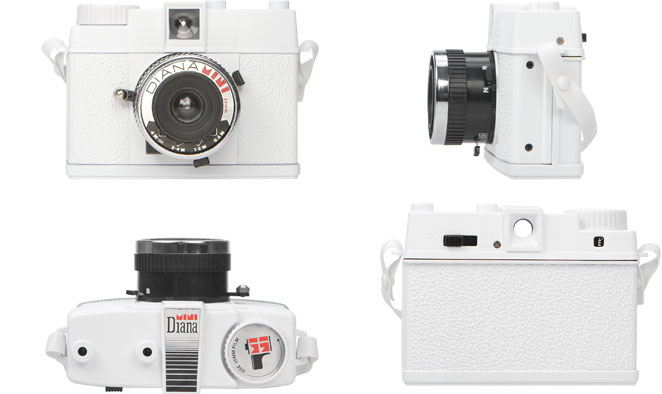
Diana Mini White - http://www.lomography.com/


The Diana Mini is essentially a shrunken down 35mm version of the popular Diana F+ which supports both the classic Diana square format and half frame photos (up to 72 photos on a roll) and retains the same design and looks of its bigger sibling.

Being intrigued by the Mini and with a recent birthday I finally laid hands on the white variant of the Diana Mini thanks to my wonderful girlfriend.

After tearing away the gift-wrap I was left with a compact yet surprisingly weighty box containing my new camera. The overall presentation was really nice with the small but perfectly formed box displaying the Mini through a see-through top panel.

Further inspection of the box revealed a book in the base which I then realised contributed most of the weight to the packaging. The book itself is filled with photos in both square and half frame formats as well introducing the camera and concepts. It also gives plenty of tips and ideas to help you get to grips with the little Diana.

Putting the book to one side and removing the inner packaging I got my first feel of this little camera and initial reaction was good. Given its plastic construction I was pleasantly surprised that it did not feel too flimsy (unlike my other ‘Lomo’ camera – the Vivitar UWS) and the textured feel running around the body added to the quality feel. It also became apparent how pretty the Mini is up close especially in its white colour variant.

A quick glance around the camera revealed the focus ring on the front of the lens and the aperture and shutter speed settings nearby along with a thread for a shutter release cable. Settings appeared fairly straightforward too with two selectable shutter speeds (‘N’ for normal exposures and ‘B’ for long exposures), two apertures (sunny and cloudy) and four focal distances (0.6m, 1-2m, 2-4m and infinity). The shutter release also sits on the side of the lens.

On top of the camera is the film winder and two holes for the pronged Diana flash whilst underneath is a fairly standard film release button, rewind handle and release to slide the back of the camera off for loading/unloading film. Finally on the back there is the viewfinder and a switch to move between the two formats available but more about those later.

With the inspection compete and a good overall first impression it was time to actually use the camera. Loading my first film was straightforward and being careful to follow the instructions in the manual meant a successful first attempt. With film loaded I headed out around my local area for some test shots.

The weather being typically British and with limited control over aperture I opted for ASA400 speed film and set the aperture in most cases to the cloudy setting unless on the rare occasion the sun broke through the clouds. The shutter selection meanwhile stayed on the ‘N’ setting throughout. It’s worth mentioning though that if you’re a little careless you could accidentally put the camera in ‘B’ mode although I managed to avoid doing so.

Looking through the viewfinder to compose shots you can see opaque bars to the left and right which help frame the shot in half frame mode or ignored if shooting in the square format. With each shot composed in the viewfinder I pulled down on the shutter release and got a satisfying SNAP each time before winding the film on for the next shot. The camera itself felt good in my hands and most of the controls including the all important shutter release are in easy reach even for my sausage-like man fingers.

I did run into one small problem on the day concerning the focussing. As this is selected via rotating dial on the front of lens I found this a little tricky to change if I had the camera at eye level. The best solution was to change the focal distance before composing the shot in the viewfinder although I sometimes forgot to do this.

As the Diana Mini supports the half frame format too I felt it wouldn’t have been a proper test without giving this a go. It states in the manual that the format has to be changed before advancing the film and that it’s best to shoot a blank frame in-between for the benefit of the processing lab. It’s worth keeping this in mind. The process for me was to switch to half frame, advance the film (being careful to stop when I felt tension), shoot a frame with the lens cap on, advance the film again and shoot as normal. When changing back to the square format I shot another blank frame with the lens cap on too.

When the day ended I went off to my nearest 1 hour processing lab and asked that they i) process the film as normal ii) scan the negatives to CD so I can crop the borders off at home and iii) don’t cut the negative. With these instructions I had my photos back within the hour and without any complications.

I have to say I was impressed with the Mini’s photos. Both the square and half frame formats looked great and save for a few focussing errors (possibly on my part) the aesthetic of the photos is exactly what I was expecting and perfectly in keeping with the ‘Lomo look’. The pairing of the Mini’s lens with a roll of Kodak Gold/Ultramax 400 returned some colourful, bright and saturated photos. Also any fears I had over camera shake when depressing the quite stiff shutter arm were dispelled as there was no sign of any. I shot some fairly uninspiring objects on the day and was pleasantly surprised when even these took on a character and certain quality.


If I had to pick faults I would say that focussing can be tricky on the fly and that you can get some waste through shooting blank frames between switching formats. Also if shooting continuously over the film you might have trouble getting the film processed at some labs.

Overall, although good value, I would find some benefit in the more expensive flash model but this is almost double the cost. In addition I can’t help feeling that although the included book is nicely presented and a good read I’m unlikely to pick it up again and wonder how much it adds to the overall cost of the package.

These are just minor gripes though and the Diana Mini definitely gets a thumbs up from me. For value, features, handling, build and more importantly the resulting photos I can’t complain. Even during this first test I haven’t yet tried double exposures or made use of the ‘B’ shutter setting so there’s plenty of experimenting left to do.

If you’re an experienced Lomographer I would seriously consider adding the Mini to your collection. If on the other hand you’re new to Lomography then consider the Mini to be an ideal first camera. It has the benefits of the Diana F’s lovely square format and dreamy lens but with all the convenience of the 35mm film format.

Leia Mais…

3 March 2011

Lomography Attacked

I was looking on Yahoo Answers recently and someone asked the question "What is so special about the Holga camera?" Before writing my response I read some of the others and found an almost hatred for the plastic cameras I have grown a fondness for.

I have to admit to not having used a Holga although I have used other similar cameras. Even with that in mind what I understand to be the question could be applied to other Lomo cameras like the Diana, etc - with a perceived low quality, lo-fi images and cult following what's so good about them?

Well nothing.

Kind of.

The camera itself on its own is nothing special but it's what you do with it that matters. People on Yahoo Answers (as seen in that example) seem to have a hatred for these plastic cameras. Ultimately though isn’t the camera just a tool just as the paint brush is to the artist?

I personally don’t care whether someone has a £40,000 medium format digital back 40 mega pixel camera or a £1 plastic piece of junk bought from a charity shop. For me art (and specifically photography) is subjective and just because an image isn't pin-sharp and exposed perfectly does not mean it cannot be a good photo in its own right. If your photo has to convey meaning or emotion, depict a scene or show personalities then who decides which types or camera are suitable for doing this?

In truth I would even go as far as saying the Lomography and photography mediums - whether film of digital - are too different to be judged against one and other on a technical basis. It’s this fact where the ‘real’ photographers get hung up on as how can something made of plastic, producing lo-fi images and accessible to all possibly create anything of any worth?

A sticking point seems to be the belief that with a Lomo camera you can take any old photo and pass it off as ‘art’ and of course you get people who probably do. But that's not limited to the Lomography crowd though. What these people seem to forget is with the rise in consumer level DSLRs popularity, how many people use their cameras on full auto and never produce anything worthwhile? Or how about those who manipulate their images in Photoshop to the point of having no resemblance to the original at all?

I say don’t get tied up in what others think, or subscribe to the view that other types of photography cannot be just as creative, artistic or valid as an art form. Do what YOU WANT and produce images YOU LIKE on any camera YOU CHOOSE. If that happens to be a £40 piece of plastic then so be it.

So no - the Holga is nothing special then just as in the wrong hands NO camera is special.

Happy snapping!

Leia Mais…